Emergency Electrical Repair Service 2026: What to Expect

Table of Contents
What Counts as an Electrical Emergency?
DIY Safety Triage: What to Do Before Help Arrives
How to Reset a Tripped Circuit Breaker (and When to Stop)
Is It Your Home or the Utility? A Quick Triage
Signs of Faulty Electrical Wiring You Should Never Ignore
Residential Electrical Panel Upgrade Cost: What Affects the Price
How to Choose a 24/7 Emergency Electrical Repair Service
Frequently Asked Questions
Last Updated: September 30, 2026
What Counts as an Electrical Emergency?
An electrical emergency is any electrical fault that poses an immediate risk of fire, shock, or injury, or that leaves your home without safe power. At Grace Mechanical Services, we tell homeowners in North Central Indiana the same thing every winter: some problems can wait until morning, and some cannot wait another minute.
Knowing the difference protects your family and your wallet. A dead outlet in one bedroom is an inconvenience. A burning smell near the electrical panel is a call to action.
The table below sorts the most common situations into three tiers.
Situation | Urgency Level | Action |
Burning smell, smoke, or sparks | Call 911, then evacuate | Treat as an active fire risk |
Buzzing panel, hot outlets, shock | Immediate emergency call | Shut off power at the main breaker if safe |
Total outage, dead circuits | Same-day service | Check the main breaker first |
One dead outlet, dim bulb | Schedule a visit | Not an emergency |
Electrical hazard signs that demand immediate action include scorch marks, a burning smell, sparking, and any shock you feel when touching an appliance or switch.
When in doubt, treat it as an emergency. No one has ever regretted calling a licensed electrician too early.
DIY Safety Triage: What to Do Before Help Arrives
The first thing to do in an electrical emergency is get people away from the hazard, then cut power at the main breaker if you can reach it safely. Never touch a person who is still in contact with a live wire.
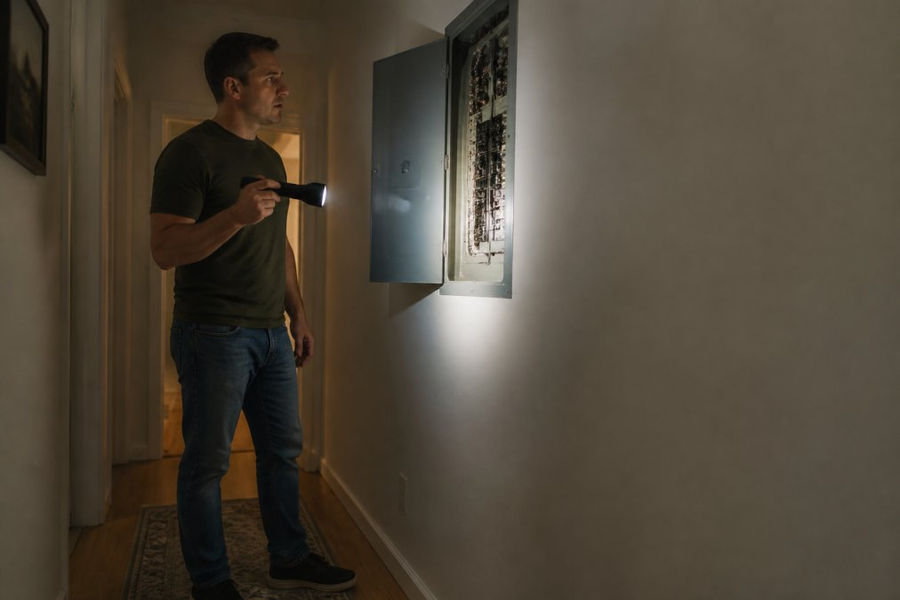
Here is the sequence we walk callers through before our truck arrives:
Move everyone, including pets, away from the affected area
If you see smoke or flames, call 911 first, then leave the house
Shut off power at the main breaker only if the panel is dry and reachable
Never touch the panel if you must stand in water to reach it
Unplug nearby appliances using a dry, non-conductive item if safe
Keep a clear path to the panel for the electrician
Note what you smelled, saw, or heard to share with the technician
Watch Out Never pour water on an electrical fire. Water conducts electricity and can turn a small fire into a fatal shock hazard. Use a fire extinguisher rated for electrical fires, then evacuate.
How to Reset a Tripped Circuit Breaker (and When to Stop)
To reset a tripped circuit breaker, find the breaker in the "off" or middle position, push it fully to "off," then flip it back to "on." If it trips again immediately, stop and call a professional.
A circuit breaker is a safety switch that cuts power when current exceeds safe levels. It protects your wiring from overheating. A short circuit or ground fault will trip it again the moment you reset it.
Step-by-step reset:
Unplug devices on that circuit
Locate the tripped breaker on the electrical panel
Push it firmly to "off," then to "on"
Restore power and watch for flickering lights
If it trips again, leave it off and call for help
A breaker that trips once is usually just an overloaded electrical load. A breaker that trips repeatedly points to a real fault.
Is It Your Home or the Utility? A Quick Triage
Before you assume the problem is inside your walls, rule out the utility side. This tells the electrician what to expect.
Signs the problem is on the utility side:
Your neighbors' lights are also out
The outage started during a storm or high wind
Half your home is dead and half is fine (a "partial outage" often means a lost leg from the transformer)
Your main breaker is on, but nothing in the house has power
Signs the problem is inside your home:
Only one circuit or one room is affected
The main breaker is on and other circuits work normally
A breaker trips again immediately after reset
You smell burning near an outlet or the panel
If you suspect a utility-side issue, call your utility's outage line first.
Key Takeaway A breaker that trips repeatedly is not a nuisance to reset. It is your electrical system telling you something is wrong. Ignoring it is how small faults become house fires.
When to stop resetting and call:
The breaker trips a second time within minutes
You see scorch marks, smell burning, or hear buzzing at the panel
The breaker feels hot to the touch
The panel is warm, discolored, or makes a crackling sound
You have to stand in water to reach the panel
Signs of Faulty Electrical Wiring You Should Never Ignore
The clearest signs of faulty electrical wiring are a burning smell, discolored outlets, warm switch plates, flickering lights, and breakers that trip without explanation.
Watch for these warnings:
Burning smell near outlets or the panel
Outlets or switch plates that feel warm
Flickering lights when appliances cycle on
Sparking or popping sounds at a receptacle
A faint burning odor you cannot place
Discolored or scorched wall plates
Voltage fluctuation that dims lights across the house
Residential Electrical Panel Upgrade Cost: What Affects the Price
The residential electrical panel upgrade cost depends on your current service size, the new panel's capacity, permit requirements, and the condition of the wiring feeding it. There is no single number.
Typical cost ranges (labor and materials, before permits):
Scope of Work | Common Range | What Drives It |
100-amp to 200-amp panel swap, same location | $1,800-$3,500 | Panel brand, breaker count, existing wiring condition |
200-amp upgrade with new meter socket | $2,500-$5,000 | Utility coordination, service entry replacement |
Panel relocation | $3,000-$6,500+ | New conduit runs, drywall repair, longer wire pulls |
Sub-panel addition | $800-$2,000 | Circuit count, distance from main panel |
What actually moves the price:
Amperage upgrade: Moving from 100-amp to 200-amp service is the most common job.
Permit and inspection fees: These vary by jurisdiction and are usually passed through at cost. Ask whether the quote includes them.
Wiring condition: Aluminum branch wiring, cloth-insulated wire, or undersized conductors can add wiring repair or replacement labor.
Panel location: A panel in a finished basement, behind drywall, or in a tight closet takes longer than one in an open garage.
Meter and service entry: Upgrades often require a new meter socket, mast, and weatherhead, plus a utility disconnect and reconnect.
Code compliance: Bringing the system up to current electrical code may require arc-fault or ground-fault breakers, a grounding electrode system upgrade, or AFCI protection on bedroom circuits.
Pro Tip Ask whether the quote includes the permit and inspection fee, and whether the utility disconnect/reconnect is billed separately. Many homeowners get surprised by a second bill after the work is done. A written, itemized estimate prevents that.
How to tell if you actually need an upgrade:
Your panel is a known problematic brand or model
The panel is more than 25 years old
You keep tripping the main breaker when multiple appliances run
You are adding a heat pump, EV charger, or large appliance
Your insurance carrier has flagged the panel during underwriting
How to Choose a 24/7 Emergency Electrical Repair Service
Use this checklist when you compare options:
Licensed electrician with a verifiable state license
Proof of insurance and bonding
A real 24-hour service line
Background-checked technicians
Written, upfront pricing before work begins
A stated emergency response window
Warranty on parts and labor
Watch Out Never hire an electrician who cannot produce a license number and proof of insurance on request. Unpermitted work can fail a home inspection and cost far more to fix than the original job.
Grace Mechanical Services handles both HVAC and electrical emergencies, so one call covers more of what can go wrong in your home.
Frequently Asked Questions
What qualifies as an electrical emergency?
An electrical emergency includes burning smells, sparking outlets, visible smoke, exposed live wires, a breaker that trips repeatedly, or a total power outage that affects safety. If you see flames or smell burning, call 911 first. For other urgent issues, contact a 24/7 emergency electrical repair service. These situations can lead to electrical fires or shock hazards if ignored.
How do I know if I need an emergency electrician immediately?
If you hear buzzing, see flickering lights along with a burning odor, or feel a shock when touching an appliance, you need immediate help. Other signs include a breaker that won't reset, scorch marks around outlets, or water leaking near electrical panels. Delaying can increase fire risk. Call a licensed emergency electrician right away; do not wait until morning.
What should I do while waiting for an emergency electrical repair service?
First, turn off power at the main breaker if it's safe to reach. Unplug affected appliances and avoid touching any exposed wires. Keep everyone away from the area. If you see smoke or flames, evacuate and call 911. Once the emergency electrical repair service arrives, they will diagnose and fix the issue. Never attempt repairs yourself beyond resetting a tripped breaker once.
Are 24/7 emergency electrical services more expensive than standard repairs?
Emergency calls often cost more due to after-hours labor and immediate dispatch. The final cost depends on the issue, parts needed, and time of day. Always ask for a written estimate before work begins.
How can I verify the credentials of an emergency electrical repair company?
Ask for their state electrical license number and proof of insurance. In Indiana, you can verify a contractor's license through the state licensing board. A reputable company will provide these without hesitation. Also check for a physical address and read recent customer reviews. Avoid anyone who pressures you or cannot show credentials.
Book a Service


Comments