Why Is My Electric Bill So High? 7 Causes and Fixes

Table of Contents
How to Read Your Electric Bill and Spot What Changed
Supply Charges vs. Delivery Fees
What a Rate Hike or Fuel Adjustment Charge Looks Like
7 Common Reasons Your Electric Bill Is So High
HVAC Problems That Drive Up Energy Consumption
Phantom Loads, Vampire Power, and Aging Appliances
Seasonal Variance and Billing Cycle Length
How to Perform a Home Energy Audit Step by Step
What You Need Before You Start
Step 1: Build Your Baseline From 12 Months of Bills
Step 2: The Night Walk for Phantom Loads
Step 3: The Air Leak Walk
Step 4: Insulation and Thermal Inspection
Step 5: Appliance and Water Heater Checks
Step 6: Rank Everything by Estimated Monthly Cost
HVAC System Efficiency Tips That Cut Energy Demand
How to Lower Your Electric Bill: Weatherization and Smart Meter Fixes
Weatherization Priorities, In Order
How to Verify Your Meter Is Actually Wrong
What Happens When You Request a Meter Test
The Cheaper Path: Ask for a Re-Read First
Financial Assistance and Rebate Programs for High Energy Bills
Conclusion
Frequently Asked Questions
Last Updated: September 20, 2026
How to Read Your Electric Bill and Spot What Changed
If you're wondering why is my electric bill so high this month, the answer is usually in the details. An electric bill shows how much power your home used, measured in kilowatt-hours, and what you owe. This guide from Grace Mechanical Services breaks down every line so you can find the real cause fast.
Supply Charges vs. Delivery Fees
Supply charges are what you pay for the electricity itself, priced per kilowatt-hour.
What a Rate Hike or Fuel Adjustment Charge Looks Like
A fuel adjustment charge reflects what your utility paid for fuel that month. It moves with fuel costs, not your habits.
Pro Tip Compare the "cost per kWh" line on this month's bill against the same month last year. If the rate is flat but your total climbed, the problem is in your home, not the utility.
7 Common Reasons Your Electric Bill Is So High
The seven usual suspects are HVAC problems, phantom loads, aging appliances, seasonal swings, billing cycle length, air leaks, and high-draw extras like space heaters and hot tubs. Most homes have two or three at once:
Cause | Warning Sign | Fast Fix |
HVAC problems | System runs nonstop | Tune-up, filter change |
Phantom loads | Devices draw power off | Smart power strips |
Aging appliances | Older fridge, old AC | Replace or service |
Seasonal variance | Bill spikes in summer/winter | Adjust thermostat |
Long billing cycle | More days on statement | Check cycle dates |
Air leaks | Rooms feel drafty | Weatherization |
High-draw extras | Space heaters, hot tubs | Use sparingly |
HVAC Problems That Drive Up Energy Consumption
Your heating and cooling system is the biggest single user of power in most homes. When it struggles, energy consumption climbs fast. Watch for:
The system runs nonstop but the house never feels right
Filters are clogged with dust
The outdoor unit is dirty or blocked
Strange noises or short cycling
Phantom Loads, Vampire Power, and Aging Appliances
Phantom load (also called vampire power) is the power electronics draw when they're off but still plugged in. Usual culprits:
Cable boxes and streaming devices
Game consoles left in rest mode
Chargers with no device attached
Older TVs and desktop computers
Seasonal Variance and Billing Cycle Length
Seasonal variance is normal, summer heat and winter cold push HVAC systems to run longer. But billing cycle length is the trap nobody checks. A billing cycle isn't always exactly 30 days; some run 33 or 34. Compare the days on this bill against last month's, if the cycle is longer, part of that jump is just extra days.
How to Perform a Home Energy Audit Step by Step
A home energy audit is a room-by-room check of where your home loses energy and wastes power. Here's the procedure, tools, and math to rank what you find.
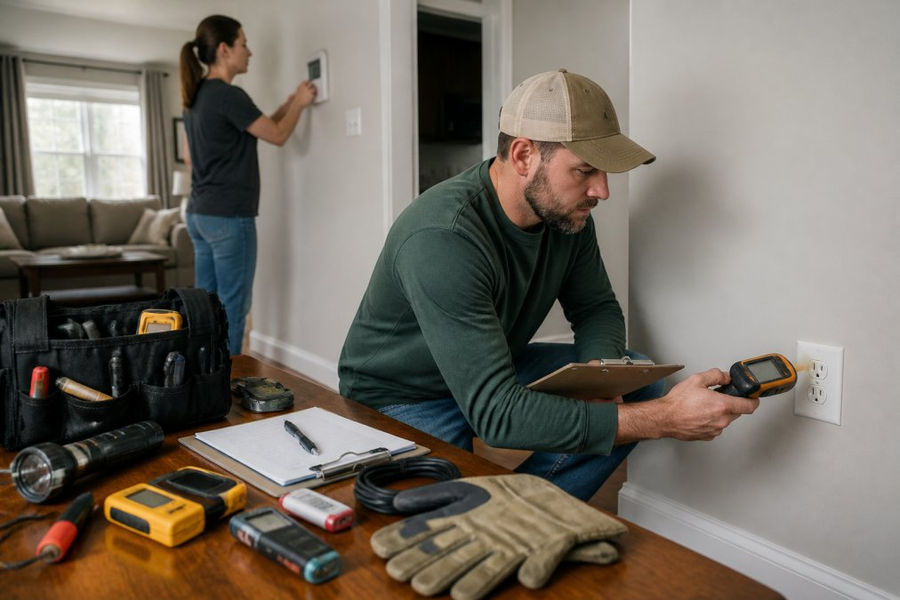
What You Need Before You Start
Four inexpensive tools turn guesswork into measurement:
Your last 12 months of utility bills (download them from your utility's online account portal)
A kill-a-watt style plug-in power meter, plugs between an appliance and the outlet and reports actual watts
A non-contact infrared thermometer, reads surface temperatures so you can find cold walls, hot ducts, and failing fridge seals
A flashlight and a roll of painter's tape, for marking problem spots as you go
A blower door test, which depressurizes the house to measure total air leakage, is the professional version. Many utilities offer a free or reduced-cost audit, so check your provider's efficiency page first.
Step 1: Build Your Baseline From 12 Months of Bills
Pull every bill from the past year. For each month, write down total kilowatt-hours used, total days in the billing cycle, and cost per kilowatt-hour. Then calculate your daily average usage, total kWh divided by days in the cycle. This normalizes for cycles that run 28 days one month and 34 the next.
Usage spikes in July and January point to HVAC.
Usage climbs gradually across all 12 months points to a failing appliance or a growing phantom load.
Usage is flat but the bill climbed points to a rate change, not a behavior change.
Step 2: The Night Walk for Phantom Loads
Turn off every light after dark and walk room to room, looking for glowing standby LEDs and devices that are warm while supposedly off. Put each on the plug-in meter for 24 hours to get its idle wattage, then multiply watts by hours by your cost per kWh for the monthly cost.
Pro Tip Group your findings. If four devices in one room each draw a small idle load, a single smart power strip that cuts current to all of them solves the whole cluster at once.
Step 3: The Air Leak Walk
On a windy day, close all exterior doors and windows, then turn on every exhaust fan, bathroom fans, range hood, and dryer. This pulls the house slightly negative in pressure and makes leaks easier to feel. Move slowly along these locations with a damp hand or a tissue:
The bottom and sides of exterior doors
Window frames, especially where the sash meets the jamb
Electrical outlets and light switches on exterior walls
Where plumbing, wiring, and ductwork penetrate the exterior shell
The attic hatch and the rim joist in the basement
Step 4: Insulation and Thermal Inspection
Use the infrared thermometer to compare surface temperatures. On a cold day, an under-insulated exterior wall reads noticeably colder than an interior wall; on a hot day, the reverse.
Check these spots:
Attic floor, insulation should be evenly thick with no compressed or missing patches
Attic hatch, often uninsulated, and one of the biggest single leaks in a house
Rim joist, the band where the floor frame meets the foundation, frequently bare
Ductwork in unconditioned space, look for disconnected joints and torn insulation
Step 5: Appliance and Water Heater Checks
Put the plug-in meter on your refrigerator for a full 24 hours. A healthy modern fridge cycles on and off; a failing one runs almost continuously. Compare its daily kWh against the yellow EnergyGuide label. For the water heater, feel the tank and the first few feet of both pipes, warm pipes mean heat is escaping.
Step 6: Rank Everything by Estimated Monthly Cost
An audit is only useful if it tells you what to fix first. For each problem, estimate the monthly cost using the numbers you collected:
Phantom loads: idle watts × hours per month ÷ 1,000 × your cost per kWh
Appliance overuse: measured daily kWh × 30 × your cost per kWh, minus what a healthy unit would use
Air leaks and insulation: harder to measure directly, so rank these by how large and how accessible the leak is
Key Takeaway The audit isn't about finding one big problem. It's about finding the three or four small ones that stack up every single month, and knowing which three to fix first.
HVAC System Efficiency Tips That Cut Energy Demand
HVAC system efficiency tips matter more than any other fix, because heating and cooling dominate your usage. Try these:
Change filters every 1-3 months. A clean filter means easier airflow.
Set the thermostat back 7-10 degrees when you're asleep or away. The system runs less overall.
Seal and insulate ductwork. Leaky ducts dump conditioned air into attics and crawlspaces.
Keep the outdoor unit clear. Trim plants and clear debris within a few feet.
Schedule a professional tune-up. A trained tech catches small issues before they become expensive failures.
How to Lower Your Electric Bill: Weatherization and Smart Meter Fixes
Learning how to lower electric bill costs starts with sealing your home and understanding your meter. Weatherization means sealing air leaks and adding insulation to strengthen your thermal envelope, the barrier between your living space and the outside.
Weatherization Priorities, In Order
Not all weatherization work pays back equally. Do these in order:
Air sealing first. Seal gaps around doors and windows with caulk and weatherstripping, and seal outlets and light switches on exterior walls with foam gaskets. It's cheap and immediately effective.
Attic insulation second. Heat rises, and an under-insulated attic is the largest thermal loss in most homes. Add insulation to attics, basements, and crawlspaces.
Duct sealing third. Leaky ducts dump conditioned air into attics and crawlspaces. Seal joints with mastic or foil tape, not cloth duct tape, which fails over time.
Fireplace damper. Close it when the fireplace isn't in use. An open damper is a direct hole to the outside.
How to Verify Your Meter Is Actually Wrong
A smart meter records your usage in near real time and transmits readings to your utility. When it misbehaves, your bill can spike for no clear reason, but before assuming the meter is faulty, rule out the more common causes. First, do the breaker test, the most useful diagnostic a homeowner can run:
Turn off the main breaker so the whole house is dead.
Note the meter's current reading.
Wait 30 to 60 minutes without turning anything back on.
Read the meter again.
What Happens When You Request a Meter Test
If the breaker test points to the meter, call your utility provider. Meter problems are their responsibility, and most states require utilities to test a meter on request, often free for the first test, with a fee if the meter is found accurate.
Is there a fee for the test, and is it refunded if the meter is found faulty?
What accuracy tolerance does the utility consider acceptable?
How far back will they adjust the bill if the meter was wrong?
Watch Out Do not tamper with or remove the meter yourself. It is utility property, and interfering with it is both dangerous and illegal in most jurisdictions.
The Cheaper Path: Ask for a Re-Read First
Before requesting a formal test, ask for a re-read. It's free, fast, and resolves a surprising share of disputed bills, estimated readings, transposed digits, and misread dials are all common. If the re-read confirms the original reading, escalate to a meter test.
Key Takeaway Run the breaker test before you call anyone. It takes an hour, costs nothing, and tells you whether the problem is the meter or your home.
Financial Assistance and Rebate Programs for High Energy Bills
Help exists if a high bill is straining your budget. Look into these programs:
LIHEAP. The Low Income Home Energy Assistance Program helps eligible households pay heating and cooling bills. Apply through your state office.
Weatherization Assistance Program. This federally funded program pays for insulation, air sealing, and efficiency fixes for qualifying homes.
Utility rebates. Many providers offer rebates on high-efficiency HVAC systems, LED lighting, and smart thermostats.
Tax credits. Federal incentives can offset part of the cost of qualifying efficiency upgrades.
Watch Out Rebate and assistance programs change every year, and funding can run out. Confirm current amounts and deadlines with your utility or state office before you count on the money.
Conclusion
A high electric bill is rarely one big mystery. It's usually small problems stacking up: a struggling HVAC system, phantom loads, air leaks, and a longer billing cycle. Fix the easy ones yourself, then bring in a pro for the systems that need real diagnosis. That's where Grace Mechanical Services comes in.
Frequently Asked Questions
What runs up your electric bill the most?
Heating and cooling equipment typically uses more electricity than anything else in a home, especially when a heat pump or electric furnace runs during extreme temperatures. Water heaters, refrigerators, clothes dryers, and dehumidifiers follow. A single space heater running several hours a day can add a noticeable amount to your monthly kilowatt-hour total. If your electric bill is so high that it surprises you, start by checking how often your HVAC system cycles and whether any large appliance runs longer than usual.
Why is my electric bill so high all of a sudden?
A sudden jump usually traces back to one of four things: a rate hike or fuel adjustment charge on your utility bill, a billing cycle that covered more days than usual, a failing HVAC component like a stuck compressor or dirty filter, or a new appliance pulling a phantom load. Compare your current bill to the same month last year, check the supply and delivery charges line by line, and note the number of billing days. If nothing on the bill explains it, schedule a home energy audit to find the source.
How can I tell if my HVAC system is causing high energy bills?
Watch for longer run times, uneven room temperatures, unusual noises, or a system that never seems to reach the thermostat setting. A dirty air filter, low refrigerant, or failing capacitor forces the system to work harder and consume more kilowatt-hours. Check your filter monthly, listen for short cycling, and compare your energy usage patterns during mild weeks versus extreme weeks. An HVAC technician can test refrigerant levels and compressor draw to confirm whether the system is the culprit.
Are there hidden electrical issues that cause high bills?
Yes. A failing water heater element, a refrigerator with a worn door gasket, or a well pump that runs constantly can quietly raise your energy consumption without any obvious sign. Older wiring and undersized panels can also cause inefficiency. If your electric bill is high and you have ruled out rate changes and weather, ask a licensed electrician to inspect major circuits and test appliance draw. Catching one failing component early often pays for the service call within a billing cycle or two.
Book a Service


Comments